Publishing my Podcast on Spotify

Spotify has been offering its podcast directory since 2016. It is very popular among Spotify subscribers.

Podcasts are offered ad-free on Spotify for both free and premium users.

Podigee supports two ways of publishing your show on Spotify:

  • Spotify (Audio) – the classic RSS-based submission. Spotify reads your Podigee feed and lists your podcast and episodes as audio.
  • Spotify Video – an API-based connection between Podigee and Spotify that publishes your episodes (audio and video) directly into Spotify, including the Spotify video player.

Pick the one that fits your show. If you have a video podcast and want it to appear with video on Spotify, use Spotify Video. If you publish audio only, the classic Spotify (Audio) export is the right choice.

Publish Podcast on Spotify (Audio)

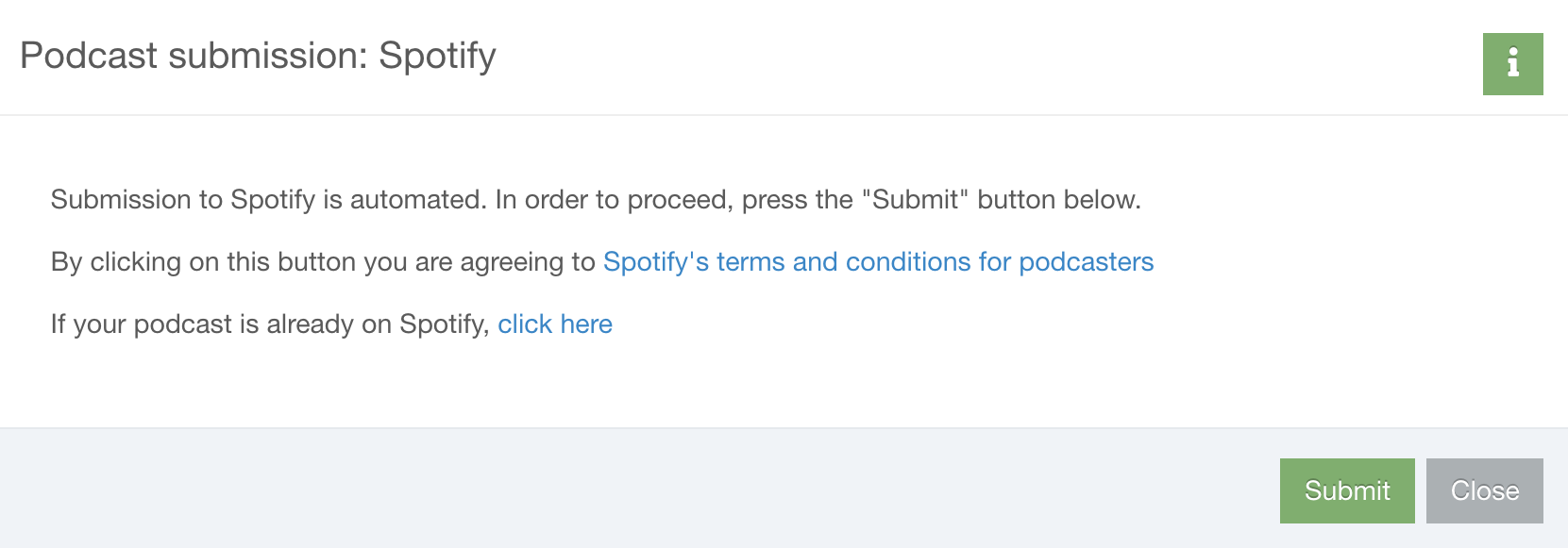
To be able to publish your podcast on Spotify, you must agree to the Terms and Conditions in the "Exports" section. Click the green button "Submit".
Initially, it takes less than an hour for your podcast to be listed on Spotify, after which new episodes are published within a few minutes.
The statistics overview also shows the views via Spotify, but only when you have had at least one view via Spotify. It may therefore take a few days before you see the Spotify statistics in your statistics overview. If you would like more detailed Spotify statistics collected by Spotify, you can also claim your podcast. 

Submitting Podcasts with Custom Domain

In case you are using your custom domain for the feed, please contact our support before submitting your podcast to Spotify.

Un-publishing Podcast from Spotify

To un-publish your podcast from Spotify, just click the blue button "Remove my podcast from Spotify" on the "Export" tab.

Changing your RSS-Feed-URL on Spotify

Unlike other podcast platforms, Spotify doesn't work with feed redirects. Therefore, if your feed URL changes, you always need to also change it on Spotify by hand.

Go to creators.spotify.com and log in via your own Spotify account. If you submitted your podcast via Podigee to Spotify, you also need to claim your podcast first: Click the button to add a new RSS feed to Spotify and add your current RSS feed. If it is already listed in Spotify, they will send you a verification code to the email, that you've entered in your podcast settings. Enter the verification code and you'll gain access to your podcast on Spotify.

Click on the Details tab in your Spotify podcast overview:

In the Details, click the update button:


Then enter the new Spotify RSS feed. Spotify will check it and update your podcast accordingly.

Note: If you have enabled Spotify Video for this podcast (see below), the public RSS feed is no longer used for Spotify. Episodes are pushed to Spotify directly via API instead, so the steps in this section do not apply to your show anymore.

Publishing Video Episodes via Spotify Video

If you record video episodes (or upload a video file alongside your audio), you can publish them as a true video podcast on Spotify using Spotify Video. Listeners will then see your episodes with video in the Spotify app, instead of audio only.

Spotify Video is an API-based connection. Once enabled, Podigee sends your show and your episodes directly to Spotify – there is no public RSS feed in between.

Requirements

  • A Podigee plan that includes video podcasts.
  • At least one published episode in your podcast.
  • Each episode you want to publish as video must include a video file in MP4 or MOV format, encoded with the H.264 video codec and AAC audio.
  • A content rating set on the episode (either standard or 18+).
  • Your episode artwork or video thumbnail uses a 16:9 aspect ratio. Podigee will use your custom thumbnail if you upload one, otherwise it generates one from the video.

If you publish an episode without a video file, Podigee will export it as audio only to Spotify Video, so your audio-only episodes still appear in your Spotify show.

Enabling Spotify Video

  1. Open the Exports section of your podcast in Podigee.
  2. Open Spotify Video and confirm that you have the rights to distribute the content and accept Spotify's terms.
  3. Click Enable.

When you enable Spotify Video, Podigee will:

  • Set up your show on Spotify via the API.
  • If your podcast is already on Spotify via the classic RSS submission, Podigee will adopt that existing show so that your followers, ratings, and historical statistics are preserved.
  • Switch your Spotify distribution from RSS to API. Your previous RSS submission to Spotify is automatically removed, because Spotify only allows one of the two methods at a time.
  • Optionally backfill your already-published episodes to Spotify Video.

Initial setup can take a few minutes. You'll see a status indicator on the Spotify Video export while this is running.

Important: Switching to Spotify Video replaces your RSS-based Spotify connection. If you later disable Spotify Video, the RSS submission is not restored automatically – you would have to submit your RSS feed to Spotify again manually at creators.spotify.com. Switching hosting providers is still possible, but it requires contacting Spotify directly.

Publishing, Updating, and Deleting Episodes

Once Spotify Video is enabled, no extra steps are needed per episode:

  • New episodes are pushed to Spotify automatically when you publish them in Podigee. Spotify then needs a short time to process the episode before it becomes visible in the app.
  • Edits to an episode in Podigee (title, description, artwork, content rating, etc.) are synced to Spotify automatically.
  • Deleting an episode in Podigee removes it from Spotify. Removal can take some time to propagate on Spotify's side.

You can see the per-episode publishing state ("queued", "sent", "published", etc.) on the episode page so you always know whether Spotify has picked up the latest version.

Spotify Video and Podigee Ads

Episodes published via Spotify Video do not run through the Podigee Ad Server. If you currently rely on Podigee Ad Server for monetization or dynamic ad insertion on Spotify, please review your setup before enabling Spotify Video.

Custom Domain

If you publish your feed under a custom domain, please contact our support before enabling Spotify Video so we can make sure the migration from your existing RSS submission goes through cleanly.

Disabling Spotify Video

You can disable Spotify Video again from the Exports section. As mentioned above, this will not automatically re-create the RSS submission to Spotify – if you want to go back to the RSS-based listing, you'll need to submit your feed again at creators.spotify.com.


Exporting Podigee Chapter Marks to Spotify

Exporting your Podigee chapter marks to Spotify is now automated! With this update, you can effortlessly enhance your listeners' experience by allowing them to navigate between chapters seamlessly on Spotify, just as you meticulously planned in your Podigee app.

Here's how it works:

  1. Open your Podigee app and navigate to the episode you want to add chapter marks to.
  2. Add your podcast markers to the episode, indicating different sections or topics
  3. Once you've added the chapter marks, save your changes.
  4. Sit back and relax! Podigee will automatically sync these chapter marks with your podcast on Spotify.


Please Note:

  • Please note that chapter marks on Spotify are currently available for podcasts using Podigee Ad Server only. If your podcast utilizes any other ad insertion technology, the chapter marks are not delivered.
  • For episodes published via Spotify Video, chapter marks follow Spotify's player behavior for video and may render differently than on audio-only episodes.
  • Read this article on what must be urgently observed and adjusted
Did this answer your question? Thanks for the feedback There was a problem submitting your feedback. Please try again later.